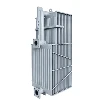

The layout of tank accessories requires careful planning. Bushing mounting bosses must be welded away from reinforcing ribs; otherwise, stress concentration at the intersection of welds can lead to cracking during operation. The oil level gauge must be positioned so that the oil level remains visible at ambient temperatures, while also avoiding direct sunlight, which could cause false readings. Grounding bushings, pressure relief valves, and gas relay ports should be located to allow maintenance personnel to conduct routine inspections without needing to climb the equipment. When integrating these accessories into the complete equipment assembly, Ruichuang Electric coordinates the tank accessory layout with the enclosure structure and foundation embeds to minimize the need for on-site rework caused by interface mismatches.
Anti-corrosion treatment and painting are often viewed merely as aesthetic matters, yet they actually determine the service life of the tank. The surface roughness of steel plates following shot blasting directly affects primer adhesion; maintaining a roughness level of Sa2.5 is standard industry practice. The total dry film thickness of the primer, intermediate coat, and topcoat generally ranges from 120 μm to 180 μm, with the upper limit applied for coastal or chemical plant environments. Sealing surfaces along the tank rim must be masked during painting, as paint accumulation on these surfaces can compromise the fit of the flange connection. Areas where welding spatter or slag has not been thoroughly removed often serve as the starting points for corrosion.