
Based on capacity, common transformer tanks fall into three basic types: box-type tanks, bell-type tanks, and sealed tanks.
(1) Box-type tanks (core-lifting type tanks). Box-type tanks are used for small and medium-sized transformers. Figure 1-17 shows the outline of a transformer equipped with a box-type tank. The top cover of this type of transformer can be opened, and its total weight after oil filling is relatively low compared to large transformers; therefore, when the transformer's active part (core and windings) requires maintenance, the entire transformer-still containing oil-can be transported to a location with lifting equipment. There, the cover can be opened and the active part lifted out for servicing. The tank walls are formed by bending steel plates, typically resulting in an elliptical or rectangular cross-section; a sealing gasket is placed between the tank rim and the cover, which are then secured with bolts. The tank rim is located at the top of the tank, connecting the cover to the rim via bolts. The cover is generally flat and is rigidly connected to the upper clamping structure of the iron yoke.
Depending on the type of radiator installed, box-type tanks can be categorized into: tubular tanks, radiator-panel tanks, and corrugated tanks.
(2) Bell-type tanks. Large transformers generally utilize bell-type tanks, as shown in Figure 1-18. The active parts of such transformers weigh over 200 tons, with total weights exceeding 300 tons, making transportation difficult. During maintenance, there is no need to lift out the heavy active part; instead, only the lighter tank shell needs to be removed to perform the work. The rim of a bell-type tank is located in the lower section, typically 250–400 mm above the tank bottom. The upper section of the tank is shaped like a bell (or hood), while the lower section generally features a trough-shaped or flat bottom; the upper and lower sections are bolted together with a sealing gasket placed between them. The lower section of the tank is also equipped with oil drain valves and oil sampling valves.
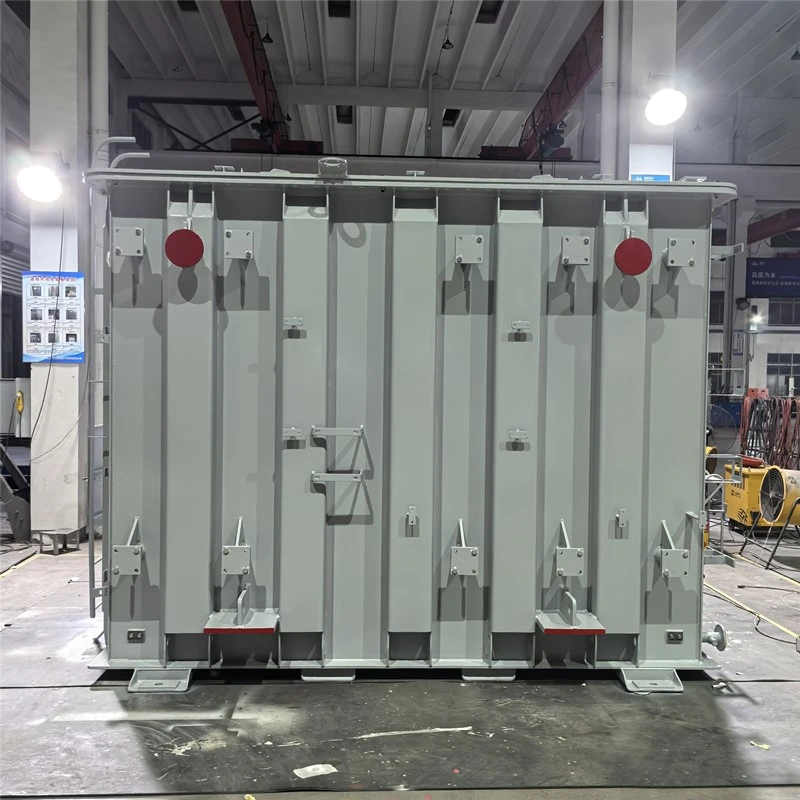
(3) Sealed-type tank. In a sealed-type tank, once the internal assembly is fully completed and placed inside the tank, the upper and lower tank rims are welded directly together rather than being bolted, forming a single, integral unit that ensures a hermetic seal. Because the tank structure is welded into one piece, lifting the internal assembly out for maintenance at the installation site is highly inconvenient; consequently, such transformers generally do not undergo internal inspections requiring the core to be lifted out-either upon arrival or during operation-which necessitates highly reliable manufacturing quality. With advancements in transformer manufacturing technology, the sealed-type structure has been increasingly adopted, and some large-scale transformers-both domestically and internationally-are now utilizing this design.