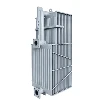

(1) The transformer tank shall be fabricated from high-strength steel plate via welding. Magnetic shielding measures shall be implemented inside the tank to minimize stray losses. The magnetic shielding must be securely fastened and properly insulated to prevent overheating or discharge caused by poor contact. All forms of electrical shielding shall ensure good electrical conductivity and reliable grounding to avoid floating discharges or adverse effects on the winding's dielectric loss factor.
The tank top shall be sloped to facilitate drainage and direct accumulated gas toward the gas relay. All openings in the tank top shall feature raised flanges. Air release plugs shall be installed at the highest point of any area where gas pockets might form; these plugs shall connect to a common manifold that directs collected gas to the gas relay. A gas collection pipe shall be added to the high- and medium-voltage bushing turrets, connecting to the piping between the tank and the gas relay. Piping leading to the gas relay shall have a slope of 1.5%. The gas relay shall be equipped with rain protection, and the gas sampling pipe shall be extended down to ground level.
A channel-steel base structure shall be provided beneath the tank bottom plate to allow the transformer to be skidded or moved along both its longitudinal and transverse axes; the base shall be equipped with necessary towing attachments. The base shall also include provisions for securing the transformer to the concrete foundation using anchor bolts. These anchor bolts must be capable of withstanding inertial forces resulting from the equipment's weight as well as displacements caused by seismic forces. The manufacturer shall submit details regarding the bolts and anchoring method to the operating entity for approval.
The tank may be constructed in two sections; if the joint is permanently welded, it must utilize re-weldable flanges and gaskets.

(2) Two grounding terminals shall be provided at diagonally opposite corners of the transformer tank bottom (grounding the transformer tank-i.e., the enclosure-is primarily intended to ensure personal safety; if the transformer's insulation fails and the enclosure becomes live, the grounding system conducts the leakage current into the earth, thereby preventing electric shock accidents).
Requirements for the grounding system of the transformer tank enclosure: ① The grounding electrode and grounding conductor shall be securely welded. ② The grounding resistance shall not exceed 0.5 Ω, and the connection between the grounding conductor and the equipment shall be reliable. ③ The diameter of the round-steel grounding electrode shall comply with relevant regulations.
(3) The transformer tank shall be equipped with the following valves: ① Drain valves for the main tank and the oil conservator; ② Oil sampling valves (these shall feature an internal thread of at least 8 mm and be fitted with a removable plug); ③ Valves for oil filtration, isolation, vacuuming, oil filling, and emergency oil drainage.